
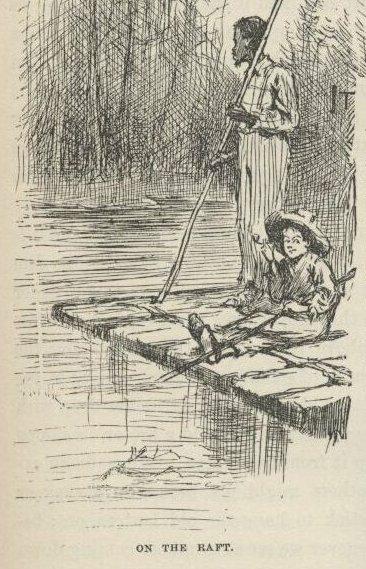
“Why, Huck, doan de French people talk de same way we does?”“No, Jim; you couldn’t understand a word they said — not a single word.”“Well, now, I be ding-busted! How do dat come?”“I don’t know; but it’s so. I got some of their jabber out of a book. Spose a man was to come to you and say Polly-voo-franzy — what would you think?”“I wouldn’ think nuff’n; I’d take en bust him over de head — dat is, if he warn’t white. I wouldn’t ’low no nigger to call me dat.”“Shucks, it ain’t calling you anything. It’s only saying, do you know how to talk French.”“Well, den, why couldn’t he say it?”“Why, he is a-saying it. That’s a Frenchman’s way of saying it.”“Well, it’s a blame’ ridicklous way, en I doan’ want to hear no mo’ ’bout it. Dey ain’ no sense in it.”“Looky here, Jim, does a cat talk like we do?”“No, a cat don’t.”“Well, does a cow?”“No, a cow don’t, nuther.”“Does a cat talk like a cow, or a cow talk like a cat?”“No, dey don’t.”“It’s natural and right for ’em to talk different from each other, ain’t it?”“ ’Course.”“And ain’t it natural and right for a cat and a cow to talk different from us?”“Why, mos’ sholy it is.”“Well, then, why ain’t it natural and right for a Frenchman to talk different from us? — you answer me that.”“Is a cat a man, Huck?”“No.”“Well, den, dey ain’t no sense in a cat talkin’ like a man. Is a cow a man? — er is a cow a cat?”“No, she ain’t either of them.”“Well, den, she ain’t got no business to talk like either one er the yuther of ’em. Is a Frenchman a man?”“Yes.”“Well, den! Dad blame it, why doan’ he talk like a man? — you answer me dat!”I see it warn’t no use wasting words — you can’t learn a nigger to argue. So I quit.
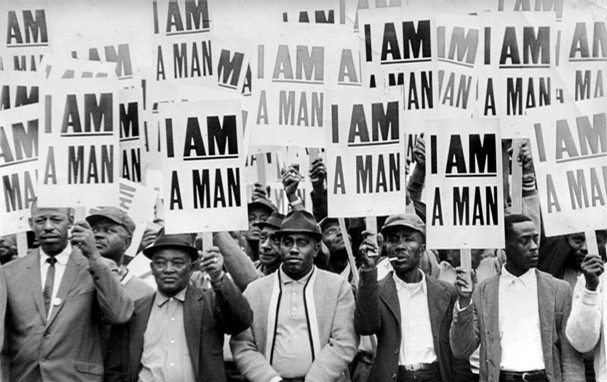
 Moreover, the passage conveys this truth not just in spite of Huck being our narrator, but through the way Huck reveals his ignorance and Jim does not. Huck dismisses Jim’s argument using an epithet that asserts that a black man is less than a man, when of course Jim, a black man, has just shown a truth deeper than differences of language or understanding: a man is a man. Jim’s point is both argument and — in showing Jim’s intellect — demonstration of what is wrong with the epithet. (This is true despite the fact that Jim himself continues to use the epithet, and appears on some level to believe it.)
The people [whom Huck and Jim] encounter are drunkards, murderers, bullies, swindlers, lynchers, thieves, liars, frauds, child abusers, numbskulls, hypocrites, windbags and traders in human flesh. All are white. The one man of honor in this phantasmagoria is black Jim, the runaway slave. “Nigger Jim,” as Twain called him to emphasize the irony of a society in which the only true gentleman was held beneath contempt.
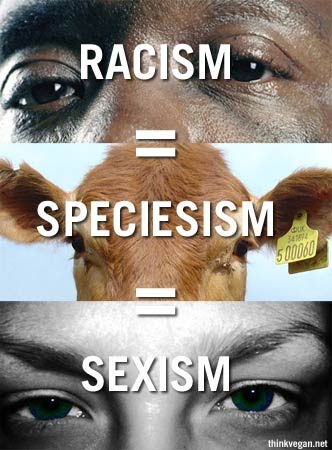 Transhumanists coopt civil rightsrhetoric, warping it in the process.Photo via flickr/ThinkVegan.
I hope the meaning of this passage, and others like it from Huck Finn — particularly the astonishing chapter after the one cited above, in which Huck plays a cruel trick on Jim — will survive. And I believe that transhumanist theorists and activists could learn a thing or two about rights, equality, persons, and (if they are interested) human beings by revisiting Twain’s great book. One transhumanist group, the Institute for Ethics and Emerging Technologies, recently announced a program to promote the idea of the “Non-Human Person.” I strongly support efforts to better our treatment of animals and the environment, and to reevaluate our historical attitude towards both as mere matter for manipulation, devoid of any moral status. But the IEET’s new program, in stating that “the general thrust of human history is toward the progressive inclusion of previously marginalized individuals and groups,” continues the transhumanist trope of claiming that the movement is carrying on the work that freed the slaves and brought civil rights to minorities — and so it would do well to acknowledge the historical facts about how civil rights advanced, and about where our equality has been understood to come from.
- The Norton Critical Edition of Adventures of Huckleberry Finn
- The New York Times on the recent Huck Finn revision controversy
- Russell Baker’s 1982 New York Times column on efforts to ban Huck Finn
- Nat Hentoff’s 1999 Jewish World Review column, excerpting Baker’s column
- The IEET announcement of its “Non-Human Person” program
- Previous Futurisms posts on transhumanism’s cooptation of civil rights rhetoric